
Blogs
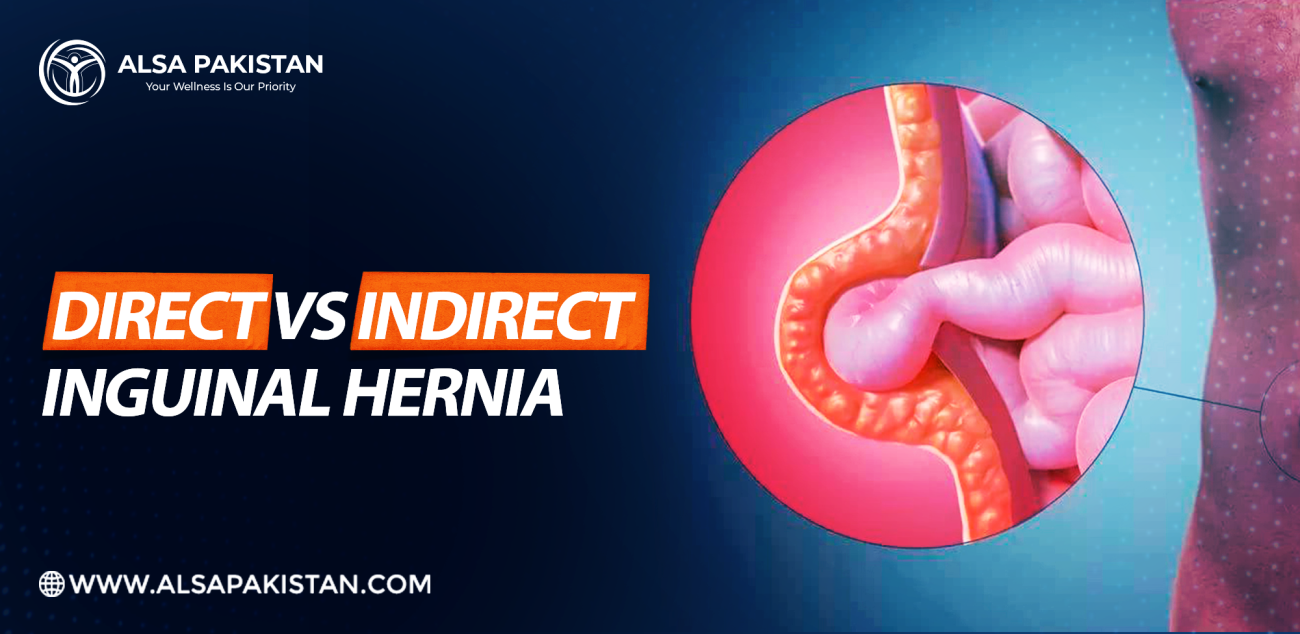
Direct vs indirect inguinal hernia
Good health is fundamental to living an active and meaningful life. However, some health issues do not get attention unless they start troubling you. Hernias fall under this category.
They may present themselves as simple swellings in the groin area. Moreover, an inguinal hernia is the most common type of abdominal wall hernia. It occurs when a part of the bowel or fatty tissue protrudes through a weakened area of the abdominal wall in the groin. While some inguinal hernias may not cause significant discomfort initially, they do not heal on their own. Inguinal hernia surgery is the most effective treatment to repair the weakened area, relieve symptoms, and help prevent complications.
The inguinal hernia can be subdivided into two types: direct inguinal hernia and indirect inguinal hernia. Indeed, anyone may find many similarities between the two, especially in terms of symptoms. In-actual, both conditions differ totaly. Dr Tahir Yunus is regarded for his expertise in the right diagnosis of complex medical conditions like inguinal hernia. Additionally, his extensive clinical experience enables him to efficiently deal with complicated situations and ensure patients' health.
This blog explains all the differences between direct and indirect inguinal hernia to help you adapt the right treatment approach.
Understanding the structure of the inguinal canal
To better understand the difference between direct vs indirect inguinal hernias, it is vital to learn the anatomy of the inguinal canal. It is an oblique structure with a length of about 4 cm. Its placement is on the lower anterior abdominal wall connecting the deep inguinal ring and the superficial inguinal ring.
The inguinal canal is an important structure that helps other organs move from the abdomen to the genitalia. However, this canal is naturally a weak point in the abdominal hernia wall, and it is a frequent location at which a hernia can develop. When there is a rise in intra-abdominal pressure due to actions, fat tissue or even part of the intestine can bulge through this area and create an inguinal hernia.
Some possible reasons are include:
- Heavy lifting
- Chronic coughing
- Being obese
- Straining during defecation
What is an indirect inguinal hernia?
The indirect inguinal hernia is defined as the passage of the abdominal contents through the inguinal ring, along the inguinal canal. It may potentially extend into the scrotum in men and the labia majora in women. This is the most frequent form of the inguinal hernia and makes up around two-thirds of all inguinal hernias.
The indirect inguinal hernia develops congenitally. It is so because it is the result of the presence of the unclosed processus vaginalis, an embryonic formation that is supposed to close following the testicular descent. If it remains open, it serves as a path for abdominal contents to herniate.
This type of inguinal hernia is recognized clinically much later in life. In particular, it appears following the increased intra-abdominal pressure because of the lifting of weights, coughing, constipation, obesity, or pregnancy.
Knowing the direct inguinal hernia
The development of a direct inguinal hernia is associated with the direct protrusion of abdominal contents through the weak point in the posterior wall of the inguinal canal. It is important to know that it does not go through the deep inguinal ring.
A direct inguinal hernia usually arises in acquired form rather than in congenital form. It often occurs among older adults due to age-associated muscle and connective tissue weakness of the abdomen.
Risk factors for direct inguinal hernias include:
- Ageing
- Chronic cough
- Heavy lifting
- Obesity
- Chronic constipation
- Prior abdominal surgery
- Smoking
Get Advanced Hernia Repair For A Stronger Tomorrow: Visit ALSA Pakistan
Meet Dr Tahir Yunus To Receive Trusted Hernia Repair You Can Count On.
Direct vs indirect inguinal hernia: Analyzing differences
The following factors are crucial in differentiating between the two hernia types.
Anatomical differences
The main distinguishing point between a direct and indirect inguinal hernia is their anatomical path.
An indirect inguinal hernia passes lateral to the inferior epigastric vessels through the inguinal ring and can pass down to the scrotum.
A direct inguinal hernia bulges medially to the inferior epigastric vessels via Hesselbach's triangle and does not extend down to the scrotum.
Hesselbach's triangle is bounded by:
Lateral border – Inferior epigastric vessels
Medial border – Rectus abdominis muscle
Inferior border – Inguinal ligament
The anatomical relationship is especially important for surgeons while performing surgery on the patient.
Clinical presentation
Both direct and indirect inguinal hernias normally cause identical signs and symptoms.
The typical ones include:
- Visible groin swelling
- Groin pain or aching
- Worsening of pain on coughing or straining
- Heavy feeling in the groin region
- Swelling that reduces when lying down
But it is crucial to note that an indirect hernia can extend to the scrotum, causing scrotal swelling. On the other hand, a direct hernia causes local swelling in the groin region and does not extend into the scrotum.
Diagnosis
The initial diagnostic steps involve thorough history taking and a physical examination.
While examining the patient, the patient is made to stand up and cough or perform the Valsalva maneuver. The findings on examination help to distinguish between the two:
- An indirect hernia normally lies along the path of the inguinal canal, appearing to come in from the deep inguinal ring.
- A direct hernia projects directly through the posterior wall of the inguinal canal.
In case the diagnosis is not clear, imaging tests may be recommended to confirm the diagnosis.
Common diagnostic imaging tests are:
- Ultrasonography
- Computed Tomography (CT scan)
- Magnetic Resonance Imaging (MRI)
Ultrasound is usually the preferred first diagnostic test due to its cost-effectiveness and high accuracy.
Treatment
The ultimate strategy to resolve the issue permanently is surgery. Below are some methods that your physician may recommend according to your condition and health status.
Watchful waiting
Individuals who have a small hernia which is asymptomatic can go without treatment. In this scenario, patients can wait, but with vigilance for any signs of complications.
Open Surgery
In open hernia repair, mesh is used to strengthen the weakened abdominal muscles. It is among the most popular surgeries around the world.
Laparoscopic Surgery
Laparoscopic hernia repairs surgery most advanced surgical method for repairing hernias. Surgeons make the necessary repair through small cuts and the specialized surgical instruments.
The list of procedures' benefits comprises:
- Smaller incisions
- Reduced pain after the surgery
- Faster recovery time
- Return to work faster
- Improved aesthetic results
Comparison at a Glance
The following summary of all aspects of both hernia types can help you get a quick comparison.
| Feature | Direct Inguinal Hernia | Indirect Inguinal Hernia |
|---|---|---|
| Cause | Acquired | Congenital |
| Age group | Often older adults | Children and young adults (mostly) |
| Risk of strangulation | Lower | Higher |
| Findings on physical examination | Projects directly through the abdominal wall | Passes through the inguinal ring |
| Treatment | Watchful wait or Surgery | Surgery |
Final Thoughts
In conclusion, the difference between direct vs indirect inguinal hernia mainly lies in their anatomy, cause, and pathway. An indirect inguinal hernia is usually congenital and passes through the deep inguinal ring, whereas a direct inguinal hernia is an acquired condition that protrudes through a weakened area of the abdominal wall within Hesselbach's triangle.
Although both can have identical clinical features like groin swelling and discomfort, a correct diagnosis is possible with the help of a competent expert like Dr Tahir Yunus. He has earned a distinction in the field due to his clinical insights and extensive experience. Surgical procedures are the best treatment options for both hernia, either through an open or a laparoscopic approach, and both are very successful.
